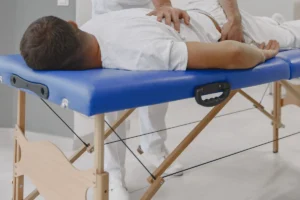

The Epley maneuver is a series of guided head and body positions that treats benign paroxysmal positional vertigo (BPPV). BPPV happens when tiny calcium crystals in the inner ear drift into a canal where they do not belong, which causes brief spinning when you move your head. The Epley maneuver uses gravity to move those crystals back out of the canal. Cleveland Clinic notes that it helps reduce BPPV symptoms in about 8 out of 10 people. A trained clinician, such as a therapist in a vertigo therapy program, first confirms that BPPV is the cause and which ear is involved.
BPPV is the most common type of vertigo, and it is usually very treatable. The word “benign” means it is not life-threatening, even though the spinning can feel intense.
This guide explains what BPPV is, how the Epley maneuver works, what happens during it and why a proper evaluation comes first.
What is BPPV?
Your inner ear holds tiny, dense grains of calcium carbonate, often called crystals (otoconia or canaliths). Normally they sit in a part of the inner ear called the utricle. In BPPV, some of these crystals come loose and move into one of the semicircular canals, the fluid-filled loops that sense head rotation. When you move your head, the crystals shift and send confusing signals to your brain, which you feel as spinning.
The cause is often unknown. The American Physical Therapy Association’s ChoosePT guide notes that head trauma, infection, Meniere disease and aging can loosen the crystals. MedlinePlus adds that a family history, a past head injury or a past inner ear infection raise the risk.
BPPV symptoms
BPPV causes short spells of spinning that come on with certain head movements, such as:
- Rolling over in bed
- Lying down
- Tilting your head back to look up
- Bending over
ChoosePT notes that the dizzy sensation is brief and intense and usually lasts about 15 to 45 seconds. Some people also feel unsteady or nauseated, and a few vomit.
How is BPPV diagnosed?
A clinician uses positional tests that move your head in specific ways while watching your eyes. When the crystals shift, they cause a particular kind of involuntary eye movement called nystagmus. One common test is the Dix-Hallpike maneuver, in which the clinician turns your head to a set position and helps you lie back quickly. Cleveland Clinic explains that this test shows which ear is causing the vertigo.
Knowing the affected ear, and which canal is involved, matters because the treatment movements are done toward that side. This is a key reason the Epley maneuver should follow a diagnosis rather than replace one.
How does the Epley maneuver work?
The Epley maneuver is a type of canalith repositioning procedure. Each position lets gravity roll the loose crystals a little further through the canal and back to the part of the inner ear where they belong. Once the crystals are out of the canal, head movements stop triggering the spinning.
The National Institute on Deafness and Other Communication Disorders (NIDCD) describes this as a series of simple movements to help dislodge the crystals from the semicircular canal. One session often works, though some people need it more than once.
What happens during the Epley maneuver?
Cleveland Clinic describes the steps a provider follows:
- Turns your head at a 45-degree angle toward the ear causing vertigo.
- Guides you to lie back quickly with your head slightly off the edge of the exam table, still turned.
- Turns your head slowly to the opposite side.
- Rotates the rest of your body so it lines up with your head.
- Has you stay on your side for a few moments.
- Helps you sit upright.
Each position is held for a short time, often about 20 to 30 seconds. The whole procedure takes about 5 to 10 minutes and may be repeated during the visit.
Your symptoms may get stronger for a moment during the lying-down part. Some people feel nauseated afterward, and vomiting is rare. Your clinician guides you through each position and helps you sit up at the end.
Other repositioning maneuvers exist too, such as the Semont maneuver. Your clinician chooses the approach based on your exam.
Who should not have the Epley maneuver?
Cleveland Clinic notes there are very few risks. Still, it may not be the best option if you have neck or back injuries, retinal detachment or vascular disease. Your provider reviews your health history before starting.
Can you do the Epley maneuver at home?
Sometimes, but only after a diagnosis and with instruction. Cleveland Clinic notes that your provider may teach you how to do it at home in case symptoms come back. It also stresses learning the correct movements first, because doing them wrong can make symptoms worse.
Doing the maneuver on your own without a diagnosis has two problems. First, the movements must be done toward the correct ear and canal. Second, other conditions can cause dizziness, and they need different care.
BPPV exercises
Besides the Epley maneuver, a clinician may teach you home exercises. MedlinePlus notes that vestibular rehabilitation or home repositioning exercises may also help, though they can take longer to work. ChoosePT notes that a physical therapist may teach you exercises that can reduce or end your symptoms and improve your balance. Ask your clinician which ones fit you.
What to expect after treatment
Cleveland Clinic notes that most people feel relief right after the procedure, while others take a few days. There are no strict aftercare rules, but avoiding sudden head movements for a while is a good idea.
BPPV can return. ChoosePT notes that within three years of a bout of BPPV, symptoms return for about 50% of people, and the treatment can be repeated if that happens. Lingering unsteadiness after the spinning stops is something a therapist can help with through balance work. Our older post on physical therapy for balance improvement explains how that works.
When to see a professional
Contact a healthcare provider if you have vertigo, especially if it is new, or if treatment has not helped. If you have already tried the Epley maneuver and still have symptoms, Cleveland Clinic advises calling your provider.
See a doctor or get medical help right away if dizziness comes with weakness, slurred speech or vision problems. MedlinePlus notes these can be signs of a more serious condition.
A doctor diagnoses the cause of dizziness. A physical therapist trained in vestibular rehabilitation can test for BPPV, perform repositioning maneuvers and help with balance. If your dizziness started after a head injury, our post on physical therapy for concussion may also help.
How OneRehab can help
OneRehab’s therapists evaluate and treat dizziness and vertigo, including BPPV. Our vertigo therapy includes canalith repositioning procedures such as the Epley maneuver, and our vestibular rehab program offers individualized exercises for balance and dizziness. You can visit either of our clinics in Dallas or Richardson. In Texas, you can see a physical therapist without a referral. To get started, book a free screen or schedule an appointment.
Common questions
How well does the Epley maneuver work?
Cleveland Clinic notes that it helps reduce BPPV symptoms in about 8 out of 10 people. Some people need it repeated.
How long does the Epley maneuver take?
About 5 to 10 minutes, according to Cleveland Clinic. It may be repeated in the same visit.
Is it normal to feel dizzy during the Epley maneuver?
Yes. Symptoms may get worse for a moment while you lie back, and some people feel nauseated afterward.
Can medicine cure BPPV?
ChoosePT notes that no medication has been found to cure BPPV. MedlinePlus adds that medicines can ease spinning but often do not work well for vertigo.
Can BPPV come back?
Yes. It returns for about half of people within three years, and the maneuver can be repeated.
Sources
- Benign positional vertigo, MedlinePlus (U.S. National Library of Medicine), reviewed 2025-07-17: https://medlineplus.gov/ency/article/001420.htm
- Epley Maneuver (Canalith Repositioning Procedure), Cleveland Clinic, updated 2025-09-21: https://my.clevelandclinic.org/health/treatments/17930-canalith-repositioning-procedure-crp
- Balance Disorders, NIDCD (National Institutes of Health), updated 2018-03-06: https://www.nidcd.nih.gov/health/balance-disorders
- Physical Therapy Guide to Benign Paroxysmal Positional Vertigo (BPPV), ChoosePT (American Physical Therapy Association), revised 2020-07-08: https://www.choosept.com/guide/physical-therapy-guide-benign-paroxysmal-positional-vertigo-bppv