Sciatica exercises are gentle stretches and strengthening moves that help you keep moving while an irritated nerve in your lower back settles down. Good options to start with include the knee-to-chest stretch, glute bridge, clamshell, bird dog and child’s pose. Do them slowly, and stop any move that makes your pain worse. Most sciatica improves over weeks to months, and a physical therapist can tailor a plan through neck and spine therapy if your leg pain is slow to ease.
Sciatica can feel alarming because the pain shoots far from where the problem starts. The reassuring news: the American Academy of Orthopaedic Surgeons (AAOS) reports that about 80 to 90% of people with sciatica get better over time without surgery.
What is sciatica?
Sciatica is not one specific diagnosis. The AAOS describes it as a broad term for nerve pain. It happens when a nerve root in your lower back is pinched, compressed or irritated. The American Physical Therapy Association’s ChoosePT guide uses the medical name, lumbar radiculopathy.
Common causes differ by age. According to the AAOS, in people under 40 the cause is typically a herniated disk. In older adults, it is more often bone spurs and arthritis. If a disc is behind your symptoms, our page on herniated disc physical therapy explains how that is treated.
What does sciatica feel like?
The NHS describes sciatica as usually affecting the bottom and back of one leg, often down into the foot and toes. People describe it as:
- A sharp, burning pain down the back of the leg
- Tingling or pins and needles
- Numbness
- Weakness in the leg
The NHS notes that the pain can be worse when you move, sneeze or cough.
How long does sciatica last?
Sciatica usually gets better in a few weeks to a few months, according to the NHS, though it can sometimes last longer or come back. ChoosePT notes that with a program of good posture, pain relief, stretching and strengthening, improvement may come in 4 to 8 weeks. Everyone’s timeline is different.
Should you rest or move with sciatica?
Gentle movement usually helps more than rest. The NHS advises carrying on with your normal activities as much as possible and starting gentle movement as soon as you can. It also recommends avoiding sitting or lying down for long periods, even if moving hurts.
The AAOS notes that your doctor may suggest short walks. Heat can help, too: the NHS suggests holding heat packs on the painful areas.
Six gentle sciatica exercises to try
These moves come from a physical therapist’s routine published by Hospital for Special Surgery (HSS). HSS suggests doing each one 8 to 10 times, per side where it applies, at least twice a week.
A few rules before you start:
- Move slowly and don’t hold your breath.
- These exercises should not cause more pain. If one does, stop right away, as HSS advises.
- A therapist can tell you which moves suit your symptoms and which to skip.
- Knee-to-chest stretch. Lie on your back with your knees bent. Slowly bring one knee toward your chest and hold it with your hands. Pull gently until you feel a mild stretch in your lower back and hip. Hold 5 to 30 seconds, then lower slowly.
- Glute bridge. Lie on your back with your knees bent and feet flat, hip-width apart. Push through your heels to lift your hips, squeezing your buttock muscles. Hold 5 to 30 seconds, then lower slowly.
- Clamshell. Lie on your side with your knees bent and feet together. Keep your feet touching as you slowly raise your top knee, like a clamshell opening. Hold 5 to 30 seconds, then lower.
- Bird dog. Start on your hands and knees. Lift one arm straight in front of you and the opposite leg straight behind you, in line with your back. Pause, then lower. Check that your back stays straight, not sagging or hunched. Repeat on the other side.
- Cobra stretch. Lie on your stomach with your hands under your shoulders. Press into your palms and slowly lift your head, chest and shoulders, keeping your elbows slightly bent. Hold up to 30 seconds, then lower slowly. Skip this one if it increases your pain.
- Child’s pose. From your hands and knees, bring your knees together and sink your hips back toward your heels. HSS says to hold for as long as feels comfortable. There’s no need to repeat it.
If you are also dealing with general low back pain, our guide to lower back pain exercises covers core moves that build on this routine.
How does physical therapy help sciatica?
A physical therapist starts by evaluating how you move, where your symptoms travel, and what makes them better or worse. From there, they design a plan around you.
ChoosePT lists several tools a physical therapist may use for lumbar radiculopathy:
- Specific motion exercises
- Mechanical traction
- Cold or heat packs
- Gentle electrical stimulation, such as TENS
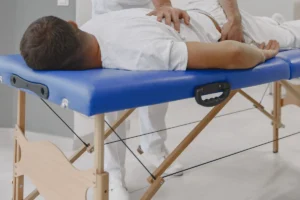
The NHS describes physiotherapy for sciatica as exercise advice plus hands-on techniques like massage. ChoosePT describes a program that combines posture, pain relief, stretching and strengthening. Learn more about our physical therapy services.
Can you prevent sciatica from coming back?
Not always, but some habits may help. ChoosePT suggests:
- Practicing good posture when sitting and standing, including when you drive.
- Using good body mechanics when you lift, push or pull.
A therapist can help you build a home routine you can keep up.
When to see a professional
Most sciatica improves with time and gentle activity. Still, it’s worth getting checked in some cases.
See a physical therapist or doctor if:
- Your symptoms last more than a week or two. HSS suggests having a doctor check you out.
- Your pain has not improved after a few weeks of home care, is getting worse, or stops you from doing your normal activities. The NHS advises seeing a doctor in these cases.
Get medical help right away if you have:
- Sciatica on both sides
- Weakness or numbness in both legs that is severe or getting worse
- Numbness around your genitals or bottom
- New trouble peeing or controlling your bladder
- New trouble controlling your bowels
- Fever, chills or night sweats along with back pain
These signs come from the NHS and HSS. They are rare, but they need prompt care. ChoosePT also notes that loss of bladder or bowel control means you should contact a medical professional immediately.
How OneRehab can help
OneRehab’s physical therapists evaluate sciatica and lower back pain and build a plan of stretching, stabilization and strengthening through our neck and spine therapy program, including care for herniated discs. You can see us at our Dallas or Richardson clinic. To talk through your symptoms first, book a free screen with a licensed physical therapist or certified athletic trainer, or schedule an appointment. In Texas, you can see a physical therapist without a referral.
Common questions
What is the fastest way to relieve sciatica?
There is no quick fix that works for everyone. Staying gently active, using heat, and doing exercises that don’t increase your pain are common first steps the NHS recommends.
Is walking good for sciatica?
It often is. The AAOS notes your doctor may suggest short walks, and the NHS advises avoiding long periods of sitting or lying down.
How long does sciatica take to go away?
The NHS says sciatica usually gets better in a few weeks to a few months, though it can last longer or return.
Will I need surgery for sciatica?
Most people don’t. The AAOS reports that about 80 to 90% of people with sciatica get better over time without surgery. Surgery decisions are made with your doctor.
Can a physical therapist help with sciatica?
Yes. A physical therapist can use exercises, posture advice, hands-on care and other tools, according to ChoosePT and the NHS.
Sources
- Sciatica, NHS, last reviewed December 3, 2024: https://www.nhs.uk/conditions/sciatica/
- Sciatica, OrthoInfo (American Academy of Orthopaedic Surgeons), n.d.: https://orthoinfo.org/diseases–conditions/sciatica
- Physical Therapist’s Guide to Lumbar Radiculopathy (Sciatica), ChoosePT (American Physical Therapy Association), revised November 20, 2017: https://www.choosept.com/guide/physical-therapy-guide-lumbar-radiculopathy-sciatica
- Stretches and Exercises to Ease Sciatica Pain, From a PT, Hospital for Special Surgery, published September 28, 2022: https://www.hss.edu/health-library/move-better/sciatica-stretches