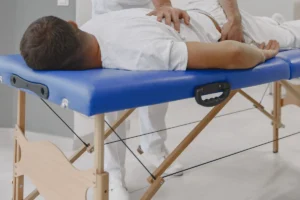

Hip replacement recovery usually follows a steady pattern. Exercises often start within a day of surgery. Most people return to light daily activities within 3 to 6 weeks, may have movement precautions for the first 6 to 8 weeks, and feel fully recovered over several months. Physical therapy guides you through each stage. OneRehab’s post-operative physical therapy is built around your surgeon’s instructions.
Please keep one point in mind as you read. Timelines and precautions vary from person to person and from surgeon to surgeon. The American Academy of Orthopaedic Surgeons (AAOS) states plainly that not all surgeons recommend the same precautions. Your surgeon’s protocol always comes first. Use this guide to understand the general picture and to prepare good questions.
What happens right after hip replacement surgery?
Some people go home the same day. Others stay in the hospital for a short time. Either way, movement starts early. Cleveland Clinic notes that your surgeon or physical therapist may give you stretches and exercises to start as soon as 24 hours after surgery.
Before you go home, the goal is usually to walk with a walker or crutches without much help. MedlinePlus advises having someone with you at home for 1 to 2 weeks after you leave the hospital or rehab center. You will also need to put only as much weight on the leg as your surgeon or therapist tells you is okay.
Simple home changes can help:
- Keep tripping hazards out of walkways.
- Add hand rails in the shower or tub and next to the toilet.
- Avoid low chairs and soft sofas. Your hips should sit higher than your knees.
- Try not to sit for more than 45 minutes at a time.
Hip replacement recovery timeline
The ranges below come from the AAOS, MedlinePlus and Cleveland Clinic. Your own progress may be quicker or slower, and that is normal.
| Time after surgery | What often happens |
|---|---|
| Same day to 24 hours | Gentle exercises begin; walking with a walker or crutches |
| 1 to 2 weeks | Someone helps at home |
| 2 to 4 weeks | Many people no longer need a walker or crutches |
| 3 to 6 weeks | Most light daily activities resume |
| First 6 to 8 weeks | Hip precautions, if your surgeon uses them |
| 6 to 12 weeks | Many people can use the hip without restrictions |
| Several months | Full recovery and ongoing physical therapy |
Return to work can take from several weeks to several months, depending on your job and your healing.
What are hip precautions, and do they apply to me?
Hip precautions are movement limits meant to lower the risk of the new hip slipping out of place. The AAOS notes that the risk of dislocation is greatest in the first few months after surgery. Your surgeon and physical therapist give you a list made for you, so it may look different from someone else’s.
Common precautions from MedlinePlus and the AAOS include:
- Don’t bend your hip past 90 degrees (a right angle).
- Don’t cross your legs or ankles.
- Keep your feet and knees pointed straight ahead, not turned in or out.
- Don’t lean forward while sitting or reach for something on the floor while seated.
- Don’t sleep on your stomach or on the side of the new hip, unless your surgeon says otherwise.
- Get into a car from street level, not from a curb or doorstep.
The AAOS says most patients can do most of the “don’ts” again after 6 to 8 weeks. Cleveland Clinic adds that these restrictions won’t be permanent. Ask your surgeon which precautions apply to you and when they end.
What exercises are common after hip replacement?
Your physical therapist will choose exercises for your stage of healing. The AAOS lists several that are often used early on. They are here so you know what to expect, not as a program to start alone. Check with your therapist or surgeon before trying them, and stop if pain sharply increases.
- Ankle pumps. Slowly push your foot up and down at the ankle. These can be done often throughout the day.
- Quad sets. Tighten your thigh muscle and try to straighten your knee. Hold for 5 to 10 seconds.
- Buttock squeezes. While lying down, tighten your buttock muscles and hold for a count of 5.
- Abduction slides. Slide your leg out to the side and back, as far as your therapist allows.
- Bed-supported knee bends. Slide your heel toward your buttocks, keeping the heel on the bed. Don’t let the knee roll inward.
Later, standing exercises are often added while you hold a sturdy chair or counter. These may include lifting the knee (not higher than your waist), moving the leg out to the side and moving it gently backward. The AAOS notes that exercises may feel uncomfortable at first but can help recovery and reduce post-operative pain.
How do walking and stairs progress?
Walking is part of your daily rehab. Stand tall with your weight balanced on your walker or crutches, and walk smoothly without hurrying. The AAOS says you can usually move to a single crutch or cane once you can walk and stand for more than 10 minutes. Follow your doctor’s instructions about walking aids.
On stairs, lead with your non-operated leg going up and your operated leg going down. Use a handrail and take one step at a time at first. If you had a knee replacement on the other side or in the past, you may notice the same stair rule applies.
How does physical therapy help after a hip replacement?
Cleveland Clinic notes that you’ll need physical therapy for a few months. A physical therapist can help you:
- Regain hip motion within the limits your surgeon sets
- Strengthen the hip and thigh muscles that support the new joint
- Walk more evenly and move off your walker, crutches or cane safely
- Practice daily tasks such as getting in and out of bed, chairs and the car
- Build back toward the activities you enjoy
The AAOS suggests continuing the exercises your physical therapist prescribes for at least 2 months after surgery. For more on how therapists assess the hip, see our hip injury therapy page.
Which activities are realistic later on?
After healing, many people enjoy walking, swimming, golf, hiking, biking and dancing. The AAOS notes that lower-impact options such as golf, cycling, doubles tennis and pickleball are often encouraged, while most surgeons advise against running, jogging, jumping and other high-impact sports. Your surgeon can tell you what fits your hip.
When to see a professional
Some pain and swelling are expected while you heal. Contact your surgeon right away if you notice any of these signs, which come from the AAOS and MedlinePlus:
- Pain in your calf or leg that is not related to the incision
- Sudden shortness of breath or chest pain
- A sudden increase in hip pain, or a feeling that the hip has slipped out of position
- A fever (the AAOS lists higher than 100°F by mouth; MedlinePlus lists higher than 101°F)
- Increasing redness, tenderness or swelling of the wound, or drainage from it
For day-to-day concerns, such as slow progress or stiffness, your physical therapist is a good first contact and can loop in your surgeon.
How OneRehab can help
OneRehab’s physical therapists provide post-operative physical therapy after joint replacements, including the hip, with plans tailored to your surgery and coordinated with your physician. We see patients at our Dallas and Richardson clinics. You can book a free screen to ask questions first, or schedule an appointment to begin therapy. In Texas you can also see a physical therapist without a referral.
Common questions
How long does it take to recover from a hip replacement?
Cleveland Clinic says it will probably take several months to recover. Many people can use the hip without restrictions after 6 to 12 weeks.
How long do hip precautions last?
It depends on your surgeon. The AAOS says most patients can do most of the “don’ts” after 6 to 8 weeks, and that not all surgeons recommend the same precautions.
When can I stop using a walker after hip replacement?
MedlinePlus says most people do not need crutches or a walker after 2 to 4 weeks. Use them for as long as you need them.
When can I drive after a hip replacement?
There is no single answer. The AAOS says it is safe to start driving again when you are no longer taking opioid pain medication, and your doctor will help you decide when.
Can I sleep on my side after hip replacement?
MedlinePlus advises not sleeping on the side of the new hip or on your stomach. The AAOS suggests asking your doctor which sleeping positions are safest for you.
Sources
- Total Hip Replacement, OrthoInfo (American Academy of Orthopaedic Surgeons), n.d. (contributor disclosures dated 2019–2023): https://www.orthoinfo.org/en/treatment/total-hip-replacement/
- Total Hip Replacement Exercise Guide, OrthoInfo (American Academy of Orthopaedic Surgeons), n.d. (contributor disclosures dated Oct–Nov 2025): https://www.orthoinfo.org/en/recovery/total-hip-replacement-exercise-guide/
- Activities After Total Hip Replacement, OrthoInfo (American Academy of Orthopaedic Surgeons), n.d. (contributor disclosures dated Oct–Nov 2025): https://www.orthoinfo.org/recovery/activities-after-hip-replacement/
- Hip joint replacement – discharge, MedlinePlus (National Library of Medicine), reviewed November 7, 2024: https://medlineplus.gov/ency/patientinstructions/000169.htm
- Taking care of your new hip joint, MedlinePlus (National Library of Medicine), reviewed November 7, 2024: https://medlineplus.gov/ency/patientinstructions/000171.htm
- Hip Replacement, Cleveland Clinic, updated July 24, 2025: https://my.clevelandclinic.org/health/treatments/17102-hip-replacement