The best lower back pain exercises are gentle ones that keep you moving and slowly build strength in your core, hips and back. Simple moves like abdominal bracing, knee-to-chest stretches, bird dogs and hip bridges are part of a spine conditioning program from the American Academy of Orthopaedic Surgeons. Staying active usually helps more than resting in bed. If your pain lingers, a physical therapist can tailor a plan to you through neck and spine therapy.
Back pain is very common. The National Institute of Arthritis and Musculoskeletal and Skin Diseases (NIAMS) notes that almost everyone has back pain at some point. The good news is that most low back pain is mild and goes away on its own, according to the American Physical Therapy Association’s ChoosePT guide.
This guide walks you through a short routine, how to do it safely, and when it is worth getting help.
Why do lower back pain exercises help?
Your spine is supported by a “belt” of muscles: your abdominals, the muscles along your back, and your hips. When these muscles are strong and flexible, they share the work of holding you upright and moving you around.
NIAMS says strengthening exercises can help decrease back pain. Cleveland Clinic adds that staying active increases blood flow to the area and helps you heal. Physical therapy can strengthen your muscles so they better support your spine.
Movement also matters for a simpler reason. Resting too much can backfire. ChoosePT notes that bed rest for longer than one day can slow your recovery.
Should you rest or stay active with back pain?
In most cases, stay as active as you comfortably can. NIAMS advises avoiding bed rest and instead limiting the specific activities or exercises that cause pain. Then you gradually increase activity as you are able.
A few practical ways to do that:
- Keep up your normal daily routine as much as you can.
- Break long tasks into shorter pieces with short movement breaks.
- Add exercises slowly, a few at a time.
- Check with your doctor or physical therapist before you start a new routine, as NIAMS recommends.
A gentle lower back pain exercise routine
The moves below come from the spine conditioning program published by the American Academy of Orthopaedic Surgeons (AAOS). Before you start, warm up for 5 to 10 minutes with low-impact activity, as the AAOS suggests. Move slowly and breathe normally.
The AAOS is clear on one key point: you should not feel pain during an exercise. If pain sharply increases, stop. A therapist can adjust the routine to fit your body and your symptoms.
Stretches
- Knee to chest. Lie on your back with your knees bent. Gently pull one knee toward your chest, hold, and lower it. Switch sides, then try both knees together. The AAOS program lists 3 sets of 10.
- Kneeling back extension. Start on your hands and knees. Slowly sit back toward your heels with your arms stretched forward, then rock forward again. The AAOS program lists 10 repetitions.
Core and hip strengthening
- Abdominal bracing. Lie on your back with your knees bent. Tighten your stomach muscles without holding your breath. Hold for 15 seconds. Repeat 5 times.
- Hip bridge. Lie on your back with your knees bent and feet flat. Lift your hips until your shoulders, hips and knees form a straight line. Hold for 15 seconds, then lower slowly. Repeat 5 times.
- Bird dog. Start on your hands and knees. Reach one arm forward and the opposite leg back, keeping your back level. Hold for 15 seconds, then switch sides. Repeat 5 times.
- Modified side plank. Lie on your side with your knees bent. Lift your hips off the floor and hold for 15 seconds. Repeat 5 times on each side.
- Plank (when ready). Rest on your forearms and lift your body into a straight line. The AAOS program builds to 30-second holds and offers an easier version if you need it.
The AAOS suggests running a program like this for 4 to 6 weeks unless your doctor or therapist tells you otherwise. If you are not sure how to do a move, or how often, ask your doctor or physical therapist.
Which exercises should you approach with care?
There is no single list of “bad” exercises for everyone. What feels fine for one person can flare up another. A few general guidelines help:
- Skip or stop any move that hurts. The AAOS says you should not feel pain during an exercise.
- Ask your doctor or physical therapist about any exercise you are unsure of, as both NIAMS and the AAOS suggest.
- Avoid heavy lifting while your back is sore. When you do lift, NIAMS suggests using your leg and stomach muscles instead of your back.
If leg pain is part of your picture, a therapist can check whether a nerve is involved and adjust your exercises.
Heat, ice and everyday habits
NIAMS notes that cold packs can help relieve some back pain, and hot packs can increase blood flow to the muscles and tissues of your back. Many people use whichever feels better.
Daily habits help, too. NIAMS recommends practicing good posture, avoiding slouching, and doing regular exercise that keeps your back muscles strong. If your back pain started after a crash, our older post on physical therapy exercises after a car accident has more ideas.
How does a physical therapist treat lower back pain?
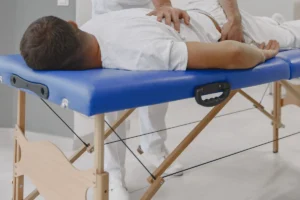
A physical therapist starts with an evaluation. They ask about your symptoms and daily life, then check how you move, your strength and your posture. From there, they build a plan for you.
According to ChoosePT, physical therapy for low back pain can include:
- Strengthening and flexibility exercises personalized to your body, needs and goals.
- Education on how to take better care of your back.
- Manual therapy, where the therapist uses their hands to improve how joints and soft tissues move.
ChoosePT also notes that for most cases of low back pain, imaging tests like X-rays and MRIs are not helpful. Your doctor decides whether you need imaging. Learn more about the benefits in our post on why physical therapy is beneficial, or see our physical therapy services.
When to see a professional
Most back pain improves with time and gentle activity. Still, there are good reasons to get checked.
Consider seeing a physical therapist if:
- Your pain lasts more than a few days or keeps getting worse. ChoosePT suggests scheduling a visit with a physical therapist in that case.
- Pain keeps coming back or limits your work, sleep or exercise.
- You are not sure which exercises are right for you.
See a doctor if your pain does not improve after a few weeks, as NIAMS advises.
See a doctor promptly if you have back pain with:
- Numbness, tingling, or weakness in your legs
- Trouble urinating, or bladder or bowel problems
- Fever or unplanned weight loss
- Pain that started after a fall or injury
- Severe pain that medicine does not help
These signs come from NIAMS and Cleveland Clinic. They are not common, but they deserve a quick medical look.
How OneRehab can help
OneRehab’s physical therapists evaluate lower back pain and build a plan of stretching, stabilization and core strengthening around your needs through our neck and spine therapy program. You can visit us at either clinic, in Dallas or Richardson. Not sure where to start? Book a free screen to have a licensed physical therapist or certified athletic trainer assess your pain and recommend next steps, or schedule an appointment. In Texas, you can also see a physical therapist without a referral.
Common questions
What is the best exercise for lower back pain?
There is no single best exercise. Core and hip strengthening moves like abdominal bracing, bird dogs and bridges, plus gentle stretches, are a common starting point. A physical therapist can choose the right ones for you.
Is walking good for lower back pain?
Staying active is generally better than bed rest. NIAMS suggests limiting the activities that hurt and gradually increasing activity as you can, so gentle everyday movement is usually a reasonable place to start.
How long does it take for back exercises to help?
It varies. The AAOS spine conditioning program is designed to run for 4 to 6 weeks unless your doctor or therapist says otherwise.
Should I use heat or ice for my lower back?
Both can help. NIAMS notes cold packs can relieve some back pain, and hot packs can increase blood flow to the muscles of your back.
Do I need an X-ray or MRI for lower back pain?
For most cases of low back pain, ChoosePT says imaging is not helpful. Your doctor will decide if a scan makes sense for you.
Sources
- Back Pain, National Institute of Arthritis and Musculoskeletal and Skin Diseases (NIAMS), last reviewed February 2023: https://www.niams.nih.gov/health-topics/back-pain
- Back Pain: Diagnosis, Treatment, and Steps to Take, NIAMS, last reviewed February 2023: https://www.niams.nih.gov/health-topics/back-pain/diagnosis-treatment-and-steps-to-take
- Physical Therapy Guide to Low Back Pain, ChoosePT (American Physical Therapy Association), revised June 29, 2023: https://www.choosept.com/guide/physical-therapy-guide-low-back-pain
- Lower Back Pain, Cleveland Clinic, last updated August 13, 2024: https://my.clevelandclinic.org/health/diseases/7936-lower-back-pain
- Spine Conditioning Program, OrthoInfo (American Academy of Orthopaedic Surgeons), n.d.: https://www.orthoinfo.org/en/recovery/spine-conditioning-program/