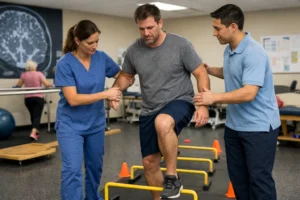

A brain injury can change ordinary life fast. One week you are driving down Central Expressway, keeping up with work, school pick-ups, and errands around Dallas. Then suddenly, balance feels off. Words take longer. Noise feels too loud. Fatigue hits hard in the middle of the day. Recovery can feel uneven, and that is often the part that frustrates people most.
At OneRehab, TBI physical therapy treatment is built around that reality. Recovery is rarely a straight line. Some people need help walking safely again. Some need support with dizziness, endurance, posture, coordination, or confidence in busy spaces. Others are dealing with a mild traumatic brain injury and feel “mostly fine” until they try to get back to normal routines and realize how much still feels off. This is where a good rehab plan matters. It gives structure to recovery and helps each step make sense.
OneRehab serves patients and families in both Dallas and Richardson. We offer physical, occupational, and speech therapy, along with specialty programs that include concussion care, traumatic brain injury care, and other neuro rehabilitation programs. Our clinic hours are Monday through Friday from 7:00 AM to 7:00 PM, and Saturday from 8:00 AM to 2:00 PM.
How TBI Physical Therapy Treatment Supports Recovery
It focuses on the body systems that often get disrupted after a brain injury. That can include balance, gait, reaction time, strength, visual motion tolerance, endurance, and the ability to move through daily tasks without feeling overwhelmed. For some people, the problem is obvious. They feel unsteady on stairs or tire quickly when walking through a grocery store. For others, the signs are more subtle. Head turns bring on dizziness. Crowded rooms feel disorienting. A simple trip from the car to the office feels harder than it used to.
Physical therapy gives those symptoms a place to be measured and worked on. Instead of guessing, you have a plan. A therapist can look at how you walk, how your head and eyes move together, how quickly you lose balance, and what happens when your body is challenged a little. Then treatment can be adjusted to your actual needs, not a generic handout.
What Recovery Can Look Like After A Brain Injury
No two recoveries look the same. A teenager returning to sports will have different goals from an adult going back to an office job, and both will differ from an older adult trying to feel safe at home again. Still, some patterns show up often in physical therapy and brain injury recovery.
You may notice:
- trouble with balance on uneven ground
- dizziness when turning your head or changing positions
- fatigue during short walks or errands
- neck stiffness or headaches that flare with activity
- reduced coordination
- slower reaction time
- fear of falling, especially in busy places
- difficulty handling dual tasks, like walking while talking
These issues can linger even when scans look reassuring or when other people assume you are already better. That gap between how you appear and how you actually feel can be exhausting. It is also one reason families appreciate a rehab team that listens before jumping to conclusions.
At OneRehab, the broader clinic model matters here. The practice describes itself as a multispecialty rehab clinic with physical therapy, occupational therapy, speech therapy, and neuro-focused services under one roof. That kind of setup can be helpful when symptoms overlap, which they often do after traumatic brain injuries.
What Is Included In A Physical Therapy Plan
A strong therapy plan should feel targeted. Not flashy, not vague, just targeted.
Depending on the person, care may include:
- gait training to improve walking pattern and safety
- balance work for standing, turning, stairs, and uneven surfaces
- vestibular exercises for dizziness and motion sensitivity
- graded endurance work to rebuild activity tolerance
- posture and movement retraining
- neck and upper body work when tension adds to symptoms
- coordination drills
- home exercise planning that feels realistic for actual daily life
This is also where TBI Physiotherapy becomes practical. The goal is not to fill an hour with random exercises. The goal is to connect treatment to what you need outside the clinic. Can you tolerate a school pickup line? Can you walk into a crowded church service without feeling pulled off balance? Can you work at your desk and still have enough energy left for dinner with your family? Those are the kinds of questions that shape useful care.
A good plan also adjusts. Some sessions push a little. Some sessions pull back. That is normal. Recovery after brain injuries often responds better to steady progression than to a hard push that leaves you wiped out for two days.
Why Families In Dallas And Richardson Need Clear Answers
Families often become the support system, scheduler, driver, note-taker, and cheerleader all at once. That is a lot. It helps when care is easier to reach and easier to understand.
OneRehab’s Dallas office is on North Central Expressway, and the Richardson office is on International Parkway. For Richardson families using transit, DART lists CityLine/Bush Station at 1300 E. President George Bush Highway, with access near the Bush Turnpike and U.S. 75. That can make planning simpler for patients or family members trying to coordinate rides around work and school.
Location matters more than people think. When someone is dealing with dizziness, fatigue, or overstimulation, even basic logistics count. A clinic that is easier to reach from Dallas or Richardson can remove one more barrier from treatment. And when appointments are available beyond a narrow weekday window, families have more room to keep care consistent. OneRehab’s hours include weekdays from 7:00 AM to 7:00 PM and Saturday hours as well.
Who May Benefit
TBI physical therapy treatment may help people at different points in recovery, including those who:
- are recovering from a concussion or mild traumatic brain injury
- feel off balance after a fall, crash, or sports injury
- have ongoing dizziness, headaches, or motion sensitivity
- want help returning to school, work, athletics, or community life
- feel weak, deconditioned, or less steady than before
- need a more structured plan for physical therapy and brain injury recovery
Some patients start therapy soon after injury. Others come in later because symptoms did not clear up the way they expected. Both situations are common. Sometimes people wait because they think they should just “push through it.” Sometimes they are told to rest, then they rest for a while, but still do not feel ready to resume normal life. A more guided rehab approach can help make that next phase less confusing.
What Patients Are Looking For
Most people are not chasing perfection. They want normal things back.
They want to:
- drive without feeling uneasy
- get through a workday with less fatigue
- walk through NorthPark or a grocery store without dizziness
- keep up with their kids
- move around the house safely
- feel less anxious about missteps, falls, or symptom flare-ups
That is why TBI physical therapy treatment should stay grounded in daily function. It is not only about what happens on the treatment table. It is about how your body handles real movement in real spaces.
Even the wider Dallas environment can shape recovery goals. Some people want enough stamina to enjoy a family outing downtown near Klyde Warren Park. Others simply want to manage a commute, a church service, or a school event without needing a full recovery day afterward.
What To Expect When You Reach Out
Starting therapy should not feel mysterious. A first step usually involves learning what happened, what symptoms are still hanging around, what activities feel hardest, and what recovery goals matter most to you. From there, a therapist can assess movement, balance, tolerance, and function, then shape treatment around those findings.
The best first visits usually do three things:
- they make the problem clearer
- they make the plan clearer
- they make the patient feel less alone with it
That might sound simple, but it matters. After a brain injury, people often carry a lot of uncertainty. Clear direction helps.
OneRehab also makes basic contact and scheduling information easy to find. The clinic provides phone support, email contact, and online appointment options.
Schedule Your Visit With OneRehab
If you or someone close to you is still dealing with dizziness, fatigue, balance issues, or reduced confidence after a brain injury, TBI physical therapy treatment may be the next practical step. You do not have to figure recovery out alone, and you do not have to wait until symptoms become more disruptive.
OneRehab offers care for patients across Dallas and Richardson, with a Dallas location on N Central Expy and a Richardson location on International Parkway. Our clinic has weekday and Saturday hours, which can help families fit therapy into work, school, and everything else that already fills the week. Call 972-845-7875 or contact the clinic online to ask questions, check availability, and get started with TBI physical therapy treatment that is built around real progress and real life.