
When Parkinson’s shows up in a family, people start connecting dots. A parent had a tremor. An uncle moved more slowly as he aged. A sibling was recently diagnosed. Then the quiet question comes up at the kitchen table, during a drive through Dallas traffic, or while waiting for an appointment: could this run in our family?
That question is fair. Parkinson’s feels personal because it can affect movement, speech, balance, mood, routines, and independence. Families in Dallas, Richardson, and nearby DFW communities often want two things at the same time. They want honest information about risk, and they want a practical plan for staying steady.
At OneRehab, we help people and families make sense of the rehab side of Parkinson’s care. We don’t replace your neurologist or genetic counselor. We work with your medical team’s guidance and focus on what life looks like now: walking across the room, getting out of a chair, speaking clearly, writing a note, or getting through the day with less fear of falling.
Is Parkinson’s Disease Hereditary or Genetic?
The direct answer is this: sometimes family genetics play a role, but most Parkinson’s cases are not passed down in a simple parent-to-child pattern. The Parkinson’s Foundation notes that Parkinson’s usually reflects a mix of genetic and environmental factors, and only about 13% of people with Parkinson’s have a known genetic link.
That matters because a family history does not guarantee a diagnosis. It also means a person with no family history can still develop Parkinson’s. The National Institute of Neurological Disorders and Stroke says the cause is unknown for most people, though some cases are inherited and can be traced to specific genetic changes.
The question, Parkinson’s Disease Hereditary, often comes from love, not panic. People want to know what to watch for, how to help, and whether their children or siblings should be concerned. Those are good reasons to talk with a medical provider, especially when more than one close relative has been diagnosed or symptoms appear at a younger age.
What Hereditary Risk Really Means
Hereditary does not mean certain. It means inherited traits may affect risk. Some gene changes can raise the chance of developing Parkinson’s, and a smaller number can be linked with familial forms of the condition. MedlinePlus explains that different genes can follow different inheritance patterns in certain Parkinson’s cases, including autosomal recessive patterns for some genes.
Put more plainly, a gene can be one part of the story without being the whole story. Your age, environment, health history, and other factors may still matter. A neurologist or genetic counselor can help you decide whether genetic testing makes sense for your family.
You may want to ask about genetic risk when:
- A parent, sibling, or child has Parkinson’s
- Several relatives on the same side of the family have had Parkinson’s or similar movement symptoms
- Symptoms began before age 50
- You are considering genetic testing and want help understanding the limits of the results
- You feel anxious because family stories are starting to sound familiar
Testing can give useful information for some families. It can also raise new questions. A result may show increased risk, uncertain meaning, or no known variant at all. That is why it helps to have the right medical guidance before and after testing.
The Causes Of Parkinson’s Disease Are Usually Mixed
The causes of Parkinson’s disease are not fully understood. Researchers often describe Parkinson’s as a condition shaped by several influences rather than one clear trigger. The Parkinson’s Foundation lists environmental factors such as head injury and pesticide exposure as possible risk influences that may interact with genetics and lifestyle.
Specific genetic changes are linked to Parkinson’s, while environmental triggers may increase risk. That does not mean one exposure or one family trait caused your diagnosis. It means Parkinson’s can be complicated, and the explanation is often less tidy than families wish.
A search for Parkinson’s Disease Hereditary can make the topic feel more certain than it is. Search results can list genes, risk factors, and symptoms in a way that feels like a checklist. Real life is messier. Two relatives may have different symptoms. One person may have tremor, while another mainly has stiffness, slow movement, balance changes, or softer speech.
That is where rehab becomes practical. You may not be able to change your family history, but you can work on strength, gait, posture, flexibility, speech, daily habits, and confidence.
How Parkinson’s Can Affect Daily Life
Parkinson’s is often known for tremor, but many people first notice smaller changes. A step gets shorter. Handwriting shrinks. A voice gets quieter. Getting dressed takes longer. Turning in bed becomes awkward. A loved one may look less expressive, even when they feel fine inside.
Common daily concerns include:
- Slower walking or shuffling steps
- Stiffness in the shoulders, hips, neck, or hands
- Trouble rising from low chairs
- Reduced arm swing while walking
- Balance changes or fear of falling
- Softer speech or unclear words
- Swallowing concerns
- Fatigue during routine tasks
- Trouble with buttons, utensils, writing, or phones
These changes can build slowly. Families sometimes adjust without noticing it. Someone starts using furniture for balance. A spouse speaks for them at restaurants because their voice is soft. A short walk around the block becomes a maybe. None of this means you have failed. It means your body needs a plan that meets it where it is.
What Parkinson’s Disease Hereditary Worries Can Mean For Your Family
Family worry can show up in quiet ways. Adult children may watch their own movements more closely. A spouse may become overprotective. Parents may avoid talking about the diagnosis because they don’t want to scare anyone. In Dallas and Richardson families, we often see the same pattern: everyone is trying to be strong, and nobody wants to be the first person to say they’re worried.
A better approach starts with plain conversation. You can separate two questions:
- What should we ask the medical team about family risk?
- What can we do right now to help this person move, speak, and function better?
The first question belongs with your physician, neurologist, or genetic counselor. The second is where rehab can help. Therapy gives the family something concrete to do, which can lower that helpless feeling a bit. Not completely, perhaps. But enough to start.
How Parkinson’s Rehab Supports Movement And Confidence
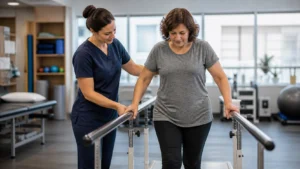
Rehab for Parkinson’s focuses on function. The goal is not to promise a cure. The goal is to help you move better, stay safer, and keep doing the parts of daily life that matter to you.
Depending on your needs, therapy may include:
- Balance and fall-risk work
- Gait training for step length, turning, and walking speed
- Strength exercises for legs, hips, core, and posture
- Flexibility work for stiffness
- Task practice for chairs, stairs, beds, and car transfers
- Fine motor support for daily activities
- Speech therapy for voice volume and clarity
- Swallowing support when eating or drinking feels harder
- Home exercise planning that fits your actual routine
Good therapy feels specific. It should not sound like a random exercise sheet. If you need to carry groceries from the car, we should talk about that. If you want to keep walking at White Rock Lake with your family, we should build toward that. If your biggest fear is falling in the bathroom at night, that deserves direct attention.
Why Early Support Helps
You do not need to wait until symptoms feel severe. In many cases, early rehab gives you a chance to build habits before movement patterns become harder to change. It can also help family members understand how to support independence without doing everything for the person.
For example, a therapist may teach cueing strategies for walking, safer ways to turn, or voice exercises that make conversation easier. Small changes can matter. A clearer path through the living room. A steadier sit-to-stand routine. A louder voice when ordering coffee. These moments may sound ordinary, but they are the stuff of independence.
The causes of parkinson’s disease may be complex, but your next step does not have to be. A good rehab plan starts with your current abilities, your home demands, and your goals.
What To Expect At OneRehab
At your first visit, we listen first. We want to know what changed, what feels frustrating, what feels unsafe, and what you still want to do. Some people come in with a new diagnosis. Others have lived with Parkinson’s for years and want a better plan after a fall, medication change, or new symptom.
A Parkinson’s rehab visit may include movement testing, balance checks, walking observation, strength review, daily activity discussion, and goal setting. If speech or swallowing concerns are present, those may be addressed through the right therapy plan as well.
We keep the conversation clear. You should leave understanding what we noticed, what we recommend, and what you can practice at home. Families are welcome to ask practical questions, because they are usually the ones helping between visits.
Local Rehab Support For Dallas And Richardson Families
Care works better when it fits real life. Dallas and Richardson families are busy. Appointments have to work around jobs, caregiving, traffic, school pickups, and ordinary errands. We keep that in mind when helping you build a plan.
Local care also makes follow-through easier. If a diagnosis has raised family concerns, you may already be juggling a lot. Rehab should bring more clarity, not more confusion.
We can help you think through:
- Which symptoms are affecting daily life most
- Which tasks feel unsafe or tiring
- How family members can help without taking over
- What to practice at home between visits
- When to share changes with your medical team
- How to adjust goals as symptoms change
Parkinson’s can feel unpredictable. A steady plan gives you something to return to.
Frequently Asked Questions
Does A Family History Mean I Will Get Parkinson’s?
No. A family history can raise questions, but it does not guarantee that you will develop Parkinson’s. Most cases are not inherited in a simple pattern. Talk with a medical provider if you have several relatives with Parkinson’s or symptoms began young in your family.
Should My Family Consider Genetic Testing?
Maybe. Genetic testing can be useful for some families, but it is not needed for everyone. A neurologist or genetic counselor can explain what testing may show, what it cannot show, and how results might affect care decisions.
Can Rehab Help If Parkinson’s Runs In My Family?
Rehab helps the person who has symptoms or a diagnosis. If you are concerned about your own risk but do not have symptoms, speak with a medical provider. If you or a loved one has movement, speech, balance, or daily function changes, therapy can help create a practical plan.
What Are The Main Causes Of Parkinson’s Disease?
The causes of parkinson’s disease usually involve a mix of factors. Genetics may play a role for some people. Age, environmental exposures, and other health factors may also contribute. For many people, there is no single clear cause.
Start With A Clearer Parkinson’s Rehab Plan In Dallas
If Parkinson’s Disease Hereditary is the question that brought you here, you are not alone. It is a common worry, and it deserves a clear answer. Genetics may matter for some families, but they are only one part of the picture.
The next practical step is to look at what Parkinson’s is changing in daily life and what can be improved with the right support. At OneRehab, we help patients and families in Dallas, Richardson, and nearby DFW communities build therapy plans around movement, speech, safety, and independence.
Reach out to schedule a Parkinson’s rehab visit. Bring your questions. Bring the family member who helps you most. We’ll help you sort through the daily challenges, one useful step at a time.